
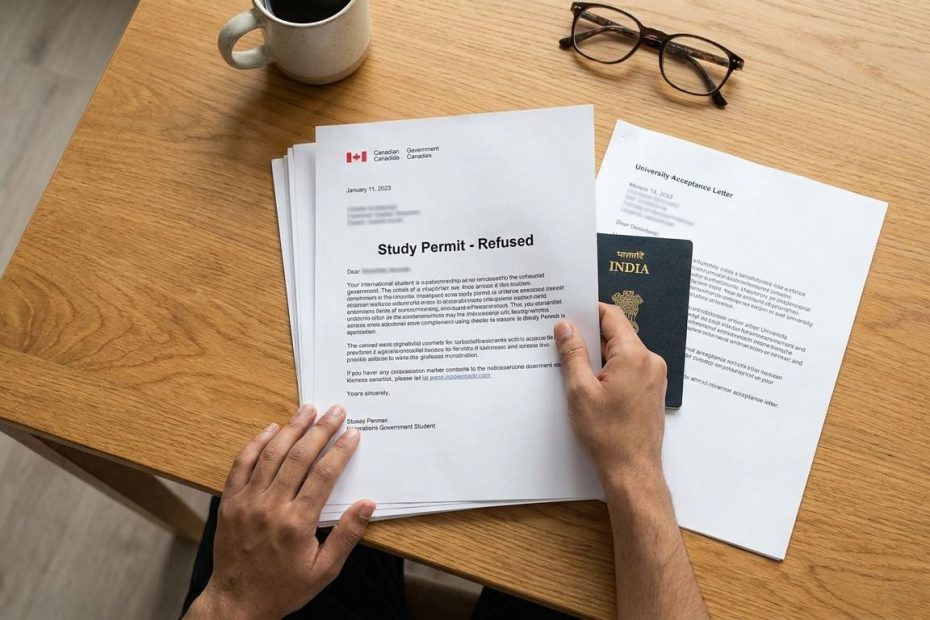
A Canada study permit is refused when the visa officer is not satisfied that your file proves genuine study, enough funds, correct documents, and a credible temporary stay. A school acceptance helps, but it does not replace the legal requirement to prove that you qualify for the permit and will follow its conditions.
If your goal is approval, your application must read like a complete, consistent, well-documented case. You will learn the refusal reasons officers usually rely on, what each refusal wording means, and how to rebuild a stronger study permit application after a rejection.
Why Does Canada Refuse Study Permits Even After A University Or College Acceptance?
A Canadian university or college acceptance letter is only one part of the study permit decision. It proves that a school admitted you, but it does not prove that Immigration, Refugees and Citizenship Canada should issue the permit. The officer still reviews your finances, academic logic, documents, identity, admissibility, ties outside Canada, and whether your stay appears temporary.
This is where many applicants misunderstand the process. A letter of acceptance does not guarantee a study permit, and a strong school brand does not fix a weak application. If your documents do not show enough money, your study plan feels disconnected from your background, or your forms contain inconsistent details, the officer can refuse the file even if the school genuinely wants you.
The current study permit environment is stricter than many applicants expect. Recent government figures show higher refusal rates for new study permit applications, and official audit findings show lower approval rates than earlier years. That means you need a file that answers the officer’s concerns before those concerns turn into refusal reasons.
At a practical level, the officer wants to see that your education plan makes sense, your money is real and available, your school is eligible, your required attestation documents are included, and your long-term plans do not undermine your temporary resident application. If one major part is weak, the refusal letter may use broad wording, but the problem is usually buried inside the documents.
Your file should connect every major point. Your past studies should support your chosen program. Your work history should support your career goal. Your funds should match tuition, living costs, and travel. Your family or economic ties outside Canada should support the promise that you will respect the permit terms.
What Does “Purpose Of Visit Is Not Consistent With A Temporary Stay” Mean?
This refusal reason usually means the officer was not satisfied that your main purpose is temporary study in Canada. The officer may believe your facts point toward a plan to remain long term, work first, join family, or use the study permit for a purpose that is not centered on education. The wording can feel vague, but it often points to a weak study plan, weak home ties, or an unclear career path.
The legal basis matters. Canadian study permit rules require the officer to be satisfied that you will leave Canada by the end of your authorized stay. This does not mean you can never have future immigration goals. It means your current study permit application must still prove that you understand and will respect temporary resident conditions.
Many refused applicants focus only on the phrase “purpose of visit” and miss the wider concern. The officer may be reacting to your program choice, your previous education, your employment history, your family situation, your finances, your travel history, or the way your statement of purpose was written. If your file says, directly or indirectly, that study is only a doorway to staying in Canada, the officer may refuse it.
A strong purpose of visit explanation answers direct questions without sounding scripted. Why this program? Why this school? Why Canada instead of another option? Why now? How does the program improve your career path outside Canada or support a lawful future plan? If those answers are missing, the officer may decide the visit does not match a temporary study purpose.
This refusal can also appear when the selected program looks lower than your current qualifications. If you already have a master’s degree and apply for a basic diploma, you need strong evidence explaining the academic or career reason. If you switch fields, the officer needs to understand the reason through documents, not just personal motivation.
How Much Money Do You Need To Show To Avoid A Canada Study Permit Refusal?
You need to show enough money to pay tuition, living expenses, and transportation without relying on future work in Canada. For many applicants outside Quebec who apply under the current financial rules, the living-expense threshold for one person is Canadian dollars 22,895, excluding tuition and travel. If family members come with you, the amount increases based on family size.
The most common mistake is treating proof of funds as a single bank balance. Officers review whether the money is available, traceable, reasonable, and consistent with your family or sponsor’s financial history. A large recent deposit with no explanation can damage the file, even when the closing balance looks strong.
Your financial package should show the full cost of study. That means first-year tuition, living expenses, travel costs, and a credible plan for the rest of the program if your studies last longer than one year. If a parent, spouse, relative, employer, or organization sponsors you, the application should include a clear support letter and supporting evidence showing that the sponsor can afford the commitment.
Bank statements matter, but they are not always enough. A stronger file may include tuition payment receipts, housing payment receipts, education loan approval, scholarship letters, guaranteed investment certificate proof, fixed deposit documents, tax records, salary slips, business registration, audited accounts, or asset documents. The right combination depends on your country, your sponsor, and your source of funds.
Your explanation should make the money easy to understand. If funds came from salary savings, show the salary pattern. If funds came from a business, show business income and withdrawals. If funds came from selling property, include sale documents and banking movement. If funds came from a loan, include approval terms, disbursement proof, and repayment capacity.
Do not build a financial file around vague promises. “My family will support me” is weak unless the file proves who will support you, how much they will provide, where the money is held, and why the support is affordable. The officer should not need to guess whether you can pay for your studies.
Can Your Study Plan Or Program Choice Cause A Canada Student Visa Rejection?
Yes, your study plan and program choice can cause a refusal. A study permit application is not only a document checklist; it is an argument that your chosen program is reasonable for you. If the program does not match your education, work history, language level, finances, or career direction, the officer may doubt that you are a genuine student.
A strong study plan connects your past, present, and future. Your previous education should explain why the Canadian program is the next logical step. Your employment background should support the skills you need. Your career goal should show how the program will be used after study. Your financial choices should match the expected career benefit.
Weak study plans often rely on broad statements. “Canada has quality education” does not explain why you chose that program. “This course will help my future” does not explain the exact role, sector, employer demand, or skill gap. “The school has good facilities” does not prove that the program is a reasonable fit for your profile.
Program level is a common risk point. If you move from a bachelor’s degree to a related graduate certificate, the plan may be easier to explain. If you move from a master’s degree to an unrelated diploma, the file needs stronger support. If you already work in one profession and choose a new field, you need documents that show a real reason for the change.
Program cost also matters. If you choose an expensive Canadian program, the officer may expect a clear return on that investment. Your application should explain how the credential improves your employment options, income potential, licensing pathway, promotion route, or business plan outside Canada. Without that explanation, the cost can look unreasonable.
You should also check whether your school and program align with your post-graduation plans. A school can be a designated learning institution, yet not every program at that school will qualify for a post-graduation work permit. If your study plan depends on post-study work, you need to verify the program details before applying.
Can A Missing Provincial Attestation Letter, Territorial Attestation Letter, Quebec Acceptance Certificate, Or Letter Of Acceptance Problem Lead To Refusal?
Yes, missing or invalid required documents can lead to refusal or a processing problem. Many study permit applicants need a provincial attestation letter or territorial attestation letter with the application unless they qualify for an exemption. If you plan to study in Quebec, you may also need a Quebec Acceptance Certificate or the required attestation wording tied to Quebec’s process.
A provincial attestation letter or territorial attestation letter confirms that you have been assigned one of the available study spaces for the province or territory where you plan to study. This document must usually be submitted with the study permit application, not added later after the officer asks. If your file requires it and it is missing, the application can fail before the officer gets to the stronger parts of your case.
Quebec has its own rules. If you will study in Quebec, you should confirm whether you need the Quebec Acceptance Certificate and whether the document includes the wording required for your situation. A valid school admission alone may not solve a missing Quebec authorization issue.
Your letter of acceptance also carries more weight than many applicants realize. The school must be a designated learning institution, and post-secondary designated learning institutions have duties tied to verifying letters of acceptance and reporting enrolment status. If the school does not verify the letter when required, or if the letter raises authenticity concerns, your application can be refused.
Document consistency matters here. Your forms, letter of acceptance, tuition receipt, passport, financial documents, provincial or territorial attestation, and study plan should match. Different program names, different start dates, different campus locations, or different tuition amounts can create doubt. Small errors can become large credibility concerns when the file already has other weaknesses.
Before submission, check the school name, designated learning institution number, campus, program title, start date, end date, tuition, refund terms, and post-graduation work permit details if relevant. Do not rely on an agent’s verbal statement. Use the official school and government sources, save records, and make sure every document supports the same story.
What Should You Do After A Canada Study Permit Refusal?
After a refusal, do not rush to submit the same application again. Reapplying with the same evidence usually repeats the same result, and it can make your record look careless. Your first move should be to identify the real refusal concern, not just the generic wording in the refusal letter.
Start by reading the refusal letter closely. Mark every reason listed: purpose of visit, funds, ties, travel history, immigration status, employment prospects, family assets, program logic, document authenticity, or missing requirements. Then compare those reasons against your submitted evidence. The officer’s concern may be valid, partly valid, or based on a misunderstanding caused by poor presentation.
Many applicants request Global Case Management System notes after refusal. These notes can reveal more detail about what the officer considered and why the application failed. Access requests through Immigration, Refugees and Citizenship Canada have specific eligibility rules, and a Canadian citizen, permanent resident, person in Canada, or qualifying corporation may need to submit the request with consent.
If the refusal appears fixable, a stronger reapplication may be the best path. A strong reapplication directly addresses the old refusal reasons and adds new evidence. It should not simply rewrite the study plan with nicer wording. It should correct the file through documents, clearer explanations, updated funds, stronger sponsor proof, stronger program logic, and cleaner forms.
If the refusal seems unreasonable or procedurally unfair, judicial review may be an option. Judicial review is not a regular appeal where you submit a brand-new application package. It is a court process focused on whether the decision was legally reasonable and fair. You should get qualified legal advice quickly because court deadlines can be short.
You should also protect your credibility after refusal. Disclose the refusal in future applications when asked. Keep copies of every submitted form, document, receipt, refusal letter, and communication. If you used a representative, request the full application package that was submitted on your behalf.
Does A Previous Canada Study Permit Refusal Hurt Your Next Application?
A previous refusal does not automatically block your next study permit application. It does, however, become part of your immigration history. The new application must disclose it when required and explain how the new file resolves the earlier concerns.
The biggest mistake is acting as if the earlier refusal never happened. Officers can see previous application history, and any failure to disclose a refusal can create a credibility problem. A routine refusal is manageable. A hidden refusal can become a serious issue because it raises questions about truthfulness.
Your next application should include a targeted refusal response. If the earlier refusal cited finances, add clearer source-of-funds proof, sponsor income documents, tuition receipts, education loan evidence, and a cost table. If the refusal cited purpose of visit, rebuild the study plan with a stronger academic and career link. If it cited ties outside Canada, add stronger proof of employment, family responsibilities, property, business, professional registration, or career prospects.
Do not overload the application with irrelevant documents. More pages do not automatically make a stronger case. The officer needs relevant evidence, clean labels, and a logical explanation. If the file becomes messy, the strongest documents may get buried.
Repeated refusals can make future applications harder, especially when the same issue appears again. A second refusal for the same reason tells the officer that the concern was not fixed. Before you reapply, make sure the new file is materially different from the old one.
Misrepresentation is different from an ordinary refusal. False documents, hidden representatives, altered bank records, fake acceptance letters, incorrect employment claims, or missing refusal history can lead to refusal and a ban from entering Canada for years. Your file should be accurate even when the truth is inconvenient.
Why Strong Applicants Still Get Refused
Strong applicants can still get refused when the file does not explain their strengths properly. Officers decide based on the documents in front of them, not on what you meant to say or what you could have submitted. If your evidence is scattered, unclear, or incomplete, the officer may not connect the dots for you.
A common pattern is a good student with weak financial presentation. The applicant has real money, but the source is unclear. The sponsor is capable, but the proof is incomplete. The tuition is paid, but living expenses and travel costs are not shown. The refusal then says insufficient funds, even though the family believes the money was available.
Another pattern is a credible student with an unclear program choice. The applicant has strong grades and real admission, but the study plan never explains why that specific program is worth the cost. The officer sees a mismatch between the applicant’s profile and the proposed studies. The refusal may then cite purpose of visit or study plan concerns.
Some refusals come from document timing. Funds appear right before submission. The provincial attestation letter is missing. The letter of acceptance has a mismatch. The passport will expire too soon. These are avoidable issues, but they can still sink a file if no one checks the package carefully before submission.
Your application should be built for a busy reader. Use clear file names, clean scans, consistent dates, and a concise explanation that directs the officer to the evidence. A strong application does not make the officer hunt for the answer.
How To Strengthen A Reapplication After Refusal
A strong reapplication begins with a refusal map. Create a table with each refusal reason, the officer’s likely concern, the evidence submitted before, the weakness in that evidence, and the new documents that fix it. This keeps the new application focused instead of emotional.
Your new study plan should answer the refusal directly. If the earlier concern was temporary stay, explain your ties outside Canada and how the program fits your career path. If the concern was program choice, explain the academic sequence and career value. If the concern was finances, add a cost breakdown and stronger proof of available funds.
Update every form carefully. A reapplication with different answers from the first application can raise concern unless the change is explained. Check employment dates, education history, family details, travel history, refusal history, addresses, and program information. Consistency is a credibility signal.
Use a clean document index. Group documents by purpose: identity, admission, attestation, finances, academics, employment, ties, explanation, and prior refusal response. This makes the file easier to review and reduces the risk that important evidence is missed.
If a representative prepared the first file, review exactly what was submitted. Applicants are responsible for the information in the application even when someone else helped. If documents were missing, altered, or submitted without your full review, address the problem before you reapply.
Do not promise outcomes you cannot control. Avoid claiming that a permit will lead to guaranteed work, guaranteed permanent residence, or guaranteed income. Keep the application grounded in education, lawful compliance, and realistic career planning.
Why Do Canada Student Visa Applications Get Rejected?
- Weak purpose of visit
- Insufficient or unclear funds
- Poor study plan
- Missing attestation documents
- Invalid school or letter issues
- Weak temporary-stay proof
- Misrepresentation concerns
Build A File That Answers The Refusal Before It Happens
A Canada study permit refusal usually comes down to proof, logic, and credibility. You need a file that shows genuine study, enough money, a valid designated learning institution admission, required provincial, territorial, or Quebec documents, and a credible plan to follow temporary resident rules. If you were refused before, do not resend the same package with minor edits. Read the refusal, request detailed notes when useful, fix the evidence, and make the reapplication stronger in every area the officer questioned. The best study permit applications do not leave major questions unanswered; they guide the officer through a clear, documented reason to approve.
References
- Immigration, Refugees and Citizenship Canada study permit eligibility requirements and student responsibilities.
- Immigration and Refugee Protection Regulations, section 216 study permit requirements.
- Immigration, Refugees and Citizenship Canada proof of financial support requirements and living-expense amounts.
- Immigration, Refugees and Citizenship Canada provincial attestation letter, territorial attestation letter, and Quebec Acceptance Certificate guidance.
- Immigration, Refugees and Citizenship Canada designated learning institution list and post-graduation work permit eligibility notes.
- Immigration, Refugees and Citizenship Canada guidance on study permit fraud, reapplying after refusal, representatives, and misrepresentation risks.
- Immigration, Refugees and Citizenship Canada Access to Information Act request guidance.
- Government of Canada parliamentary briefing data on study permit refusal and approval rates.
- Auditor General of Canada report on International Student Program reforms, approval rates, letter-of-acceptance verification, and program integrity findings.
- Federal Court Study Permit Pilot Project information for judicial review of refused study permit applications.
- ApplyBoard analysis of post-secondary study permit application and approval trends.